NJT GP40s have been the backbone of their fleet since the early 90s. From the ex-CNJ variants, to the MK rebuilds, to the largest order of ex-Conrail GP40s rebuilt at the Juniata Shops, the GP40s have been one of the most recognizable locomotives in Northeast passenger service. Thanks to Cometcrush and Flamerailzzz Trainz, these venerable locomotives are now available for Trainz Railroad Simulator!
NJT GP40PH-2 4100-4112
The CNJ was actually the first railroad to order a passenger version of the GP40 — the GP40P. EMD built 13 of them in October 1968 (roughly road numbers CNJ 3671–3683), funded through an NJDOT grant to modernize the Raritan Valley Line and North Jersey Coast Line equipment. These locomotives, built in 1968, were used on the CNJ’s Raritan Valley Line and North Jersey Coast Line, and were funded through a grant provided by the New Jersey Department of Transportation. They originally carried steam generators to heat conventional coaches. Worldwide Rails
Conrail era (1976–1983)
CNJ’s passenger operations were transferred to NJDOT in 1976, with Conrail operating them under contract, and it’s here the units got renumbered into the 4100-4112 block you’re asking about — a jumbled renumbering that didn’t necessarily match their original CNJ order sequence (you can see in the roster that 4100-4103 came from CNJ 3681, 3672, 3675, and 3676, for instance).

NJ Transit takeover (1983)
In 1983, New Jersey Transit assumed operating passenger rail service in the state, inheriting the units under the NJTR 4100-4112 numbers. Shortly after, the steam generator was replaced with a diesel HEP generator, and the units were reclassified as GP40PH.
The GP40PH-2 rebuild (1991–93)
NJ Transit had Conrail’s shops rebuild the whole fleet to Dash-2 electrical standards, add Caterpillar-powered diesel HEP generators, and extend the roofline/hood profile — a complete rebuild from the frame to the roof. This is when they officially became GP40PH-2s, and — notably — during this rebuild, the locomotive numbers would be changed around, except that of #4101, which would remain the same going all the way back to Conrail days.
Attrition has been steady — #4105 was the first to fall victim to mechanical problems when its HEP motor failed, and #4112 was bumped to work-train duty in 2014 after its HEP also went out. Per Wikipedia’s current roster, only 4100, 4101, and 4109 remain active in revenue passenger service today, out of the original 13 — rebuilt by Conrail 1991–1993. NJ Transit has leaned into that survivor status too: 4101 was unveiled in October 2022 as part of the Heritage Fleet, repainted into the NJDOT-era “Bluebird” scheme, while 4109 got a CNJ-scheme repaint back in 2019 for NJ Transit’s 40th anniversary.
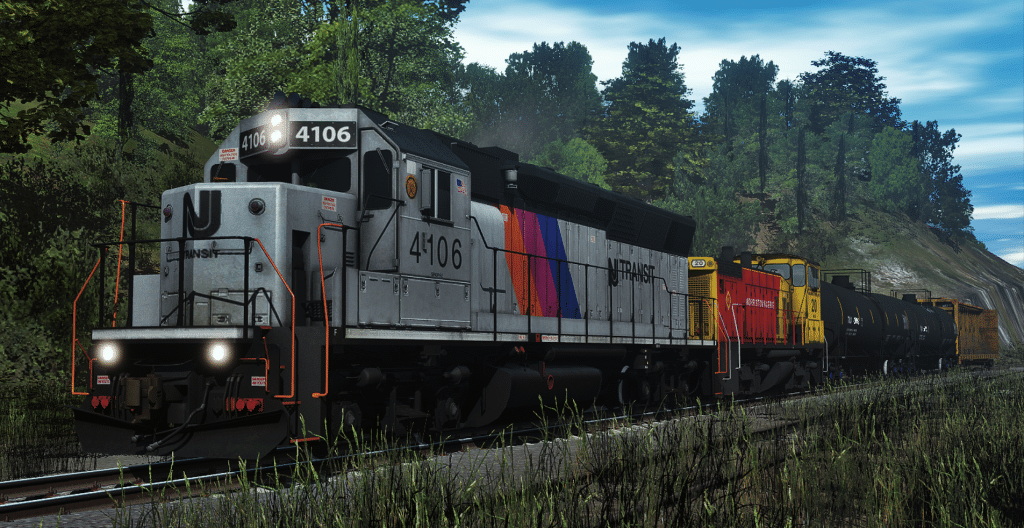
NJT GP40PH-2A Morrison-Knudsen Rebuilds
Unlike the ex-CNJ 4100-4112 (which started life as purpose-built GP40P passenger units), the GP40PH-2A group started as plain freight GP40s pulled from all over the map. NJ Transit needed additional passenger power in the early ’90s and, rather than order new locomotives, contracted Morrison-Knudsen to build six more passenger-based GP40s designated GP40PH-2A, built from standard freight GP40s derived from various railroads throughout the country.
The order
These became NJT 4145-4150, ordered and rebuilt in 1993. The first order in 1993 consisted of six units rebuilt by Morrison-Knudsen, designated GP40PH-2A, distinguishing them from the subsequent 19-unit order (4200s) that Conrail’s Juniata Shops rebuilt around the same time and which got the GP40PH-2B designation instead.
Donor locomotives — a real mixed bag: Because these were culled from the freight fleet, their pedigrees varied unit to unit:
- 4145 traces back to Baltimore & Ohio 4032 (built 1971), which bounced through B&O renumberings, then CSX as 6607, before being retired February 21, 1991, and rebuilt by Morrison Knudsen on February 17, 1993, as NJT 4145.
- 4147 started as Penn Central 3174 (built Nov. 1968), became Conrail 3174 in April 1976, was sold to Kansas City Southern as 751 in January 1984, renumbered 4751 in June 1999, and rebuilt as GP40PH-2 by Morrison Knudsen in May 1993 as NJT 4147.
- 4150 came from Penn Central 3134 (1968), later Conrail, then Kansas City Southern #763 before its own M-K rebuild.
- Other units in the group had B&O, CSX, and Penn Central lineage, per the roster note that they were Morrison-Knudsen rebuilds from GP40s.

Service life
These units never quite had the glamour of the ex-CNJ fleet. This order was reportedly kept in storage at points due to underuse, though NJ Transit’s equipment shortages led to at least one unit — 4145 — being loaned out to MARC in Maryland in exchange for the use of MARC single-level coaches. One later mishap: 4148 was wrecked in 1996 and rebuilt in 1997 — though note some sources attribute that later rebuild to Conrail rather than M-K, so there’s a bit of ambiguity in exactly who touched 4148 the second time around.
Where it fits in the bigger picture
So by the mid-90s NJ Transit’s GP40-family passenger fleet had three distinct rebuild lineages: the ex-CNJ GP40PH-2s (4100-4112, purpose-built passenger units), the GP40PH-2A (4145-4150, M-K freight-to-passenger conversions), and the GP40PH-2B (4200s, ex-Penn Central units rebuilt by Conrail at Juniata). All three groups eventually converged into NJ Transit’s broader diesel roster serving similar commuter routes.
NJT GP40PH-2B 4200 Series
The GP40PH-2B was NJ Transit’s largest of the three GP40 passenger rebuild programs. While the ex-CNJ 4100-4112 series were purpose-built passenger units, and the GP40PH-2A (4145-4150) was a small Morrison-Knudsen conversion job, the GP40PH-2B involved 19 former Penn Central freight units rebuilt by Conrail. These became NJT numbers 4200-4219, built originally between 1965-1969, and acquired/converted by NJ Transit in 1993-94.
Rebuilt by the Juniata Locomotive Shops
Unlike the Morrison-Knudsen rebuilds, the GP40PH-2Bs were converted at Conrail’s Juniata Shops in Altoona, Pennsylvania — the historic former Pennsylvania Railroad shop complex. Between 1993 and 1994, Conrail’s Juniata Shops rebuilt these former freight GP40s into GP40PH-2B configuration, extending the frame and installing a secondary HEP (Head End Power) motor to power lights, HVAC, and other systems on passenger cars.

Donor Locomotive Lineage
All units in this series trace back to Penn Central/Conrail freight stock, giving the group a more uniform pedigree than the mixed-origin GP40PH-2A series.
4208 — Originally built as a freight GP40 for Penn Central, passed into Conrail’s fleet after the 1976 Conrail consolidation, later rebuilt into GP40PH-2B configuration.
4210 — One of the more notable units in the fleet. Started as Penn Central GP40 #3182 — the same locomotive that famously ran away and gouged three-foot-deep grooves into Boston’s Southeast Expressway (I-93) in 1969. After that incident, it was eventually rebuilt at Juniata and arrived at NJ Transit in May 1994 as GP40PH-2B #4210.
4219 — Has the most unusual path of the group. Began as a Louisville & Nashville GP40 (#3026), was first rebuilt by Morrison-Knudsen into GP40PH-2A #4148, then after being wrecked in the 1996 Bergen Junction wreck, was rebuilt a second time — this time by Juniata Locomotive Works — into GP40PH-2B #4219. This effectively crossed the unit over from the 2A rebuild lineage into the 2B lineage.

Naming Convention
The “B” suffix denotes the third order of GP40PH-2 rebuilds for NJ Transit (following the original GP40PH-2 and the GP40PH-2A orders).
Legacy and Heritage Paint
The GP40PH-2B block became NJ Transit’s largest and longest-lived GP40 rebuild group. Several units have received heritage liveries:
- 4202 was repainted in the PRSL colors in the fall of 2025.
- 4208 was repainted into Conrail blue in fall 2024, honoring Conrail’s 1976-1983 operation of NJ passenger service.
- 4210 was unveiled in an Erie Railroad black-and-yellow heritage scheme.
